
Architectural Design Standards
September 23, 2009
ADS 5.1 Building Variety
| Residential | |||
| V | VI | VII | VIII |
ADS 5.1.1 Intent.
To ensure building diversity, multi-building developments consisting of a single building type shall contain buildings that exhibit different building forms.
ADS 5.1.2 Standard.
Developments with at least five (5) buildings of the same building type shall be required to use more than one building form according to the following table.
|
For This Total Number of Buildings of the Same Building Type: |
This is the Minimum Number of Building Forms Required: |
|
At least 5; less than 15 |
2 Different Building Forms |
|
At least 15 |
3 Different Building Forms |
ADS 5.1.3 Different Building Form.
Different building form shall mean a building contains at least two (2) of the following when compared to another building:
- A distinct change in building footprint.
- A distinct change in building height.
- A distinct change in building materials.
- A distinct change in building details.
ADS 5.1.4 Distinct Change in Building Height.
A distinct change in building height shall be a difference in building height of at least one story for the entire footprint of the building.
ADS 5.1.5 Distinct Change in Building Details.
A distinct change in building details shall include, but shall not be limited to, one of the following:
- Change in window type.
- Change in window, door, or wall trim.
- Change in roof form, excluding changes in roof pitch.
ADS 5.1.6 Configuration.
Buildings with similar forms shall generally be grouped together to form a neighborhood.
ADS 5.1.7 Exemptions.
Buildings in a Mixed-Use District (MXD) shall be exempt from this standard.
|
Don’t Do This |
|
|---|---|
|
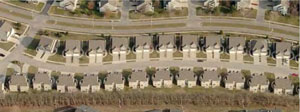
This duplex development of more than 15 buildings repeats the same building form for the entire length of the development; it should contain at least three different building forms. |
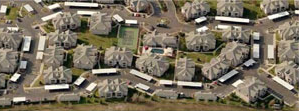
The apartment complex of more than 15 buildings repeats a single building form throughout the development; is should contain at least three different building forms. |
| Examples of Changing Building Form | |
|---|---|
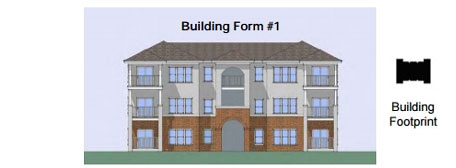
Initial Building Form. This building elevation and footprint will be altered below to two different building forms.
|
|
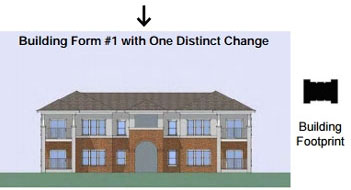
Change #1: A Distinct Change in Building Height. The building changes in height from three stories to two stories for the entire footprint of the building.
|
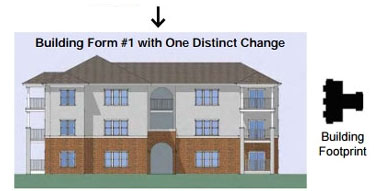
Change #1: A Distinct Change in Building Footprint. The building changes in footprint.
|
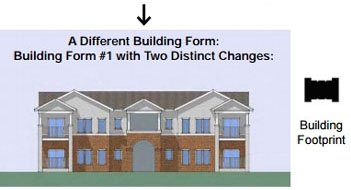
Change #2: A Distinct Change in Building Details. The building changes in roof type from hipped to gabled and the window type changes from double-hung to casement.
|
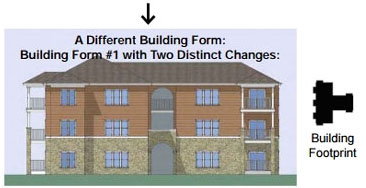
Change #2: A Distinct Change in Building Materials. The building changes in materials from brick and stucco to stone and lap siding.
|
Effective on: 1/1/1901