
Title 18 - Unified Development Ordinance
18.440 Signs
18.440.200 Definitions
For the purposes of this Chapter, these words and phrases shall have the following meaning:
A-frame sign. A portable sign that is in the shape of an "A" with back to back sign faces, an easel, or a similar configuration.
Artworks. Works of art or integral decorative or architectural features of buildings that do not have moving parts or moving lights. “Works of art” means drawings, pictures, symbols, paintings (including the painting of patterns or designs) or sculptures.
Attached sign. A sign installed on a building.
Attention-attracting device. Any device with flashing, blinking, rotating or moving action or the appearance thereof, or any searchlight, costumed person or balloons designed or intended to attract the attention of the public to an establishment or the device. Provided, this shall not include an approved digital display.
Banner. A temporary, generally flexible sign constructed of plastic or vinyl.
Billboard. A freestanding sign or sign structure upon which copy is placed on a poster or panel and and mounted on a pole or structure, typically as follows: (1) posts or pole supports with secondary support (A-frame) and a single display panel, (2) multi-mast structure constructed with poles, I-beam or equivalent as primary support and a single display panel, or (3) monopole structure constructed with support, framing and a single display panel with a foundation.
Building entry sign. A sign located next to the entry of a building, for instance, in the case of a multi-tenant building with one entry and central corridor, where tenants do not have individual exterior entries. (Examples include, but are not limited to, a listing of tenants, directions to tenant spaces, etc.)
Business. Typically a commercial or industrial entity, a public or private organization or agency, a not-for-profit entity, or a similar organizational entity operating independent of other such businesses on the same site. Provided, for the purposes of this Chapter a “business” will include any tenant or occupant of an office, commercial or industrial development. A business is considered independent of other businesses on the same site if it: (1) has its own exterior entry that leads directly to its own interior space that is physically defined and can be physically separated from the interior space of any other business; (2) has its own employees that are scheduled and supervised separately from any adjacent business; (3) has separate cash registers or payment systems for any merchandise that is sold or service that is rendered; and (4) has separate storage, processing or fabrication areas from any adjacent business.
Changeable copy. A sign where the text message is changed by hand, or in a non-mechanized manner.
Design element. A theme established throughout the development on buildings, parking structures, light pole banners, monument signs, etc. (Examples include, but are not limited to, a logo, development initials, other emblem, etc.)
Detached sign. Any sign located on the ground or on a structure located on the ground and not attached to a building.
Detached canopy sign. A sign installed on a canopy structure that is detached from the building.
Development entry monument sign. A sign located at the entry to a subdivision or development.
Digital display. Any sign, graphic display, or portion thereof, where the content or graphic display is designed to be changeable or moveable by electronic, electro-mechanical or optical means. A television used for the purpose of signage is considered to be a digital display.
Directly illuminated sign. Any sign where the source of illumination of the sign, such as, but not limited to, an incandescent bulb, neon tube or fluorescent tube, is visible to a person standing on the ground.
Facade. The area directly adjacent to a particular business’ tenant space or building floor area. “Facade” or “business facade” includes parapet walls, canopies, towers or similar building features that are directly adjacent to and clearly associated with the business’ tenant space or building floor area, but does not include any facade area adjacent to and clearly associated with another business or with a vacant tenant space or building floor area. No part of a building may be counted as part of more than one business facade. Where a business utilizes more than one building or structure, or occupies a building with multiple building surfaces or planes, the “facade” shall be equal to all of the building surfaces that are oriented in the same direction or within 45 degrees of the same direction.
Feather sign. A banner in the shape of a feather, quill, sail, blade or teardrop, and mounted on a solid or flexible pole or cord. These are sometimes referred to as “quill signs” or “sail banners.”
Ground floor tenant wall sign. A wall sign located on the ground floor of a multi-story building occupied by a tenant or occupant having a facade and an exterior door leading directly to its occupied space.
Halo illumination. A source of illumination entirely within an individual letter, cabinet or structure which makes the sign visible at night by means of lighting the background upon which the individual letters are mounted. The letters are typically opaque, and thus are silhouetted against the background. The source of illumination is not visible. Also called “internal indirect” or “reverse channel” lighting.
Incidental sign. A sign in addition to the primary sign for the property that has a purpose secondary to the allowed use of the property. (Examples include, but are not limited to, leasing information, directional information, etc.)
Indirectly illuminated / indirect illumination. Partial or complete illumination of a sign at any time by a light source which is shielded as to not be visible at eye level.
Internal subdivision monument sign. Monument sign located internal to a subdivision. (Examples include, but are not limited to, entry markers to various phases of the subdivision, etc.)
Internally illuminated / internal illumination (or “backlighted”). A sign which is illuminated from a light source located inside or behind the sign face and where light is transmitted through a translucent material that is part of the sign face or surface surrounding the sign face.
Kiosk. A freestanding pedestrian-oriented structure upon which messages are posted.
|
Kiosk
|
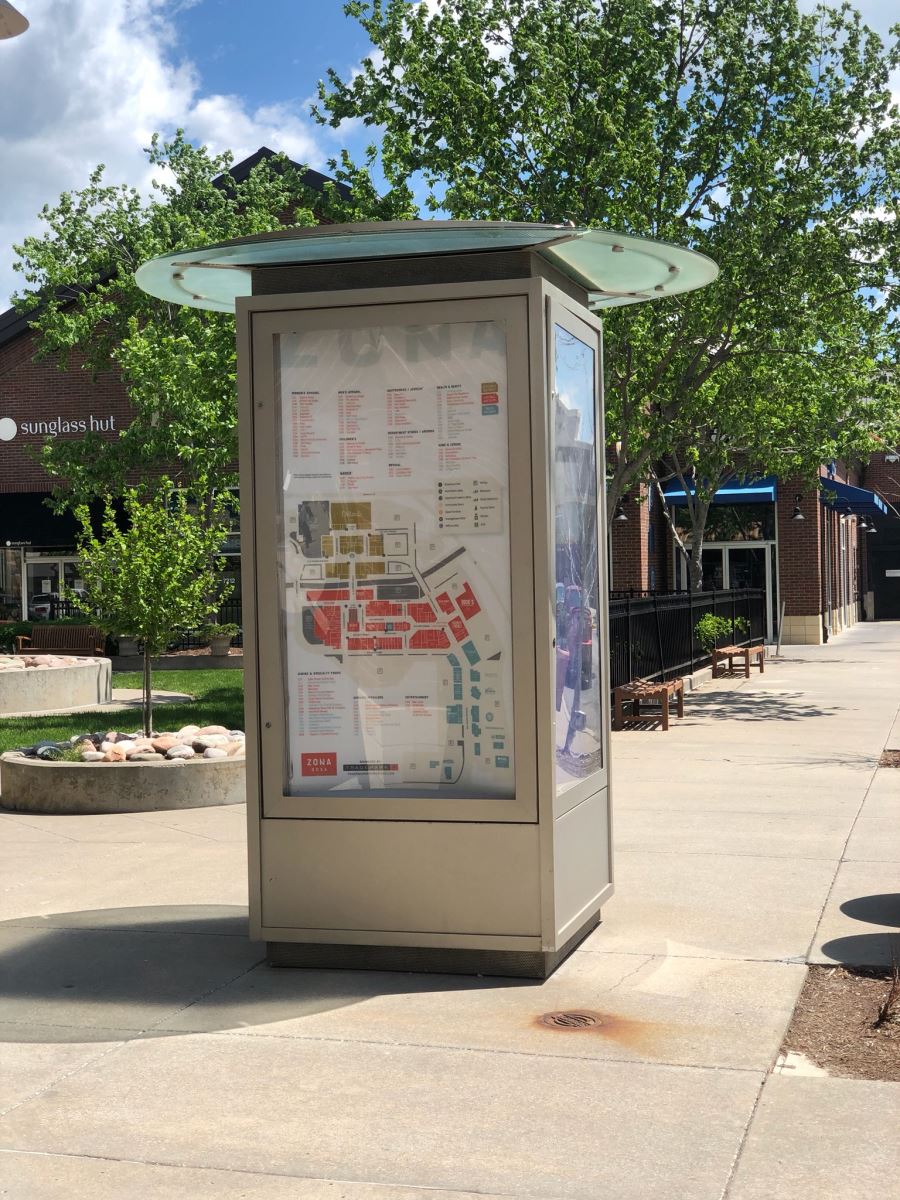 |
| Example of a Kiosk |
Light pole banner. Fabric banner mounted on a light pole that is periodically replaced.
Monument sign. A detached sign where the width of the base of the sign is a minimum of one-half the width of the widest part of the sign face.
Neon sign. A directly illuminated sign or display which is a free-formed surface or tubular shape that creates words, numerals, figures, devices, designs, trademarks or logos, and for which the light source is luminescent gas.
Nonconforming sign. A sign that, on the effective date of this Chapter, does not conform to one or more of the regulations set forth in this Chapter.
Obsolete sign. A sign for a business, product, service or activity which is no longer conducted or available on the premises.
Off-site commercial sign. A sign with commercial content that refers to a for-profit business, organization, product, activity or service that is not located or available on the premises where the sign is located. “Off-site commercial sign” includes, but is not limited to, signs affixed or painted onto structures such as benches and shelters, and freestanding signs commonly referred to as Billboards.
Off-site sign. A sign where the information provided is not specific to the property on which it is located. (Examples include, but are not limited to, real estate pointer signs referring to residential properties other than the property where the sign is located, etc.)
Painted wall sign. Any sign painted directly upon a wall surface.
Parking area sign. Sign within parking lots and internal circulation areas at a building site entry, at key intersections within the site and at each drive-through facility entry.
Permanent display for temporary messages. A permanent frame or display where a development may install temporary signs or messages within the designated area of the permanent frame or display without requiring a Special Event Permit or being subject to the sign area, height, or time limits of 18.440.130.
Point-of-activity sign. A sign directed to the person at the location where an activity or transaction occurs, whether freestanding or on a menu board, product dispenser, etc. (Examples include, but are not limited to, menu boards, gas pumps, ATMs, etc.)
Pole sign. A detached sign with one or more vertical sign supports that does not meet the definition of a “monument sign.”
Portable sign. A sign that is designed to be readily movable from location to location either by being carried or by being towed or pulled. (Examples include, but are not limited to, A-frame and movable billboard signs.)
Projecting sign. Any sign extending more than one foot from the face of the building to which it is attached.
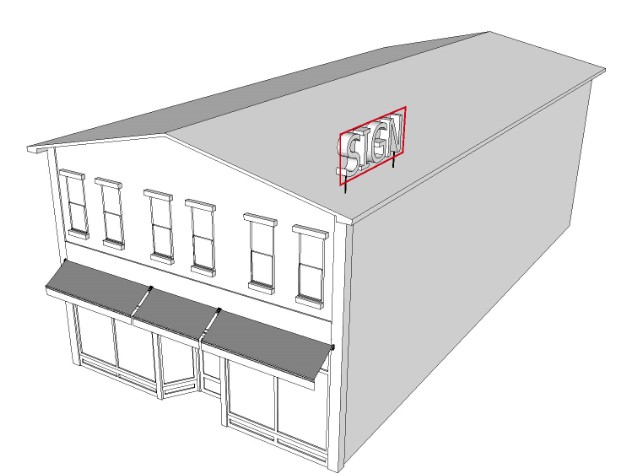
Roof sign. A sign located upon the roof of the building and having the roof as a principal means of sign support. No roof sign allowed by this Chapter shall extend above the roofline. See 18.440.100 and 18.440.110. Signs mounted on the upper edge of an awning or canopy are not considered roof signs.
|
Roof Sign
|
|
 |
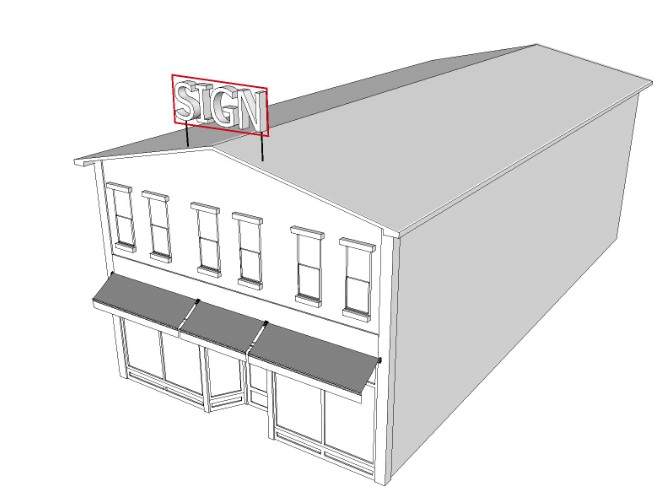 |
| Good example of a roof sign | Bad example of a roof sign |
Sign. Any surface or object which is used to display or which is fabricated to create words, numerals, figures, devices, designs, trademarks or logos, and which is sufficiently visible to persons located outside of any building to attract the attention of such persons or to communicate information to them. “Sign” includes sign supports.
Sign area. See 18.440.050.
Sign face. The surface of a sign that is separated from the front of any other sign face on the same sign structure by an exterior angle of at least 270 degrees.
Sign maintenance. The normal care and minor repair that is necessary to retain a safe, attractive and finished structure, frame, pole, brackets or surface.
Sign support. The supporting members of the sign such as frame poles, brackets or structures by which a sign is mounted on or affixed to a building or the ground.
Snipe sign. Any temporary sign which is attached to a fence, window, tree, shrub, utility pole, benches, street lights, portable stand or temporary structure, or any sign which is not securely fastened to a building or firmly anchored to the ground. Snipe sign does not include A-frame signs authorized by 18.440.030.D.2 or temporary signs authorized by 18.440.130.
Stake sign. A temporary, rigid sign constructed of plastic, vinyl, metal, or wood.
Subtenant. An establishment which leases space and conducts business or activities within another establishment (primary tenant) but does not have an exterior facade and a dedicated entry leading directly to the subtenant space. The subtenant's business is a separate legal entity from the primary tenant's business, as opposed to a department, division or subsidiary of the primary tenant's business. Entities within an enclosed shopping mall or activities that are conducted primarily by automated machines are not considered subtenants.
Temporary sign. A sign constructed of durable and/or non-durable materials, such as cloth, canvas, cardboard, paper, fabric, wood, metal or plastic, with or without a structural frame, displayed for a limited period of time. This includes but is not limited to banners, feather signs, and stake signs. This definition does not authorize temporary signs that are prohibited by 18.440.020. (Examples of temporary signs are as follows, provided that these examples are intended to assist in interpreting this code and not to restrict the content of signs: political signs, public demonstrations, grand opening signs, contractor signs, real estate signs, and signs that announce an event such as a carnival, circus, or similar event.)
Under canopy sign. A sign mounted under a building canopy.
Wall sign. Any sign attached to and erected parallel to and within 1 foot of the face or wall of a building, including signs painted on or projected on the walls of buildings. “Wall sign” includes signs attached to or printed on canopies, awnings, mansard roofs or similar near-vertical elements of a building facade, but which are not part of the building roof. Near-vertical shall refer to a pitch exceeding 1:3 (1 foot horizontal and 3 feet vertical).
Window sign. A sign installed on the interior of a window so that it is visible outside the building.
(History: Ord. No. ZRR-3300 §21, 2020)
Effective on: 1/1/1901