
Title 18 - Unified Development Ordinance
18.440 Signs
18.440.050 Regulations Applicable to All Signs in All Districts
-
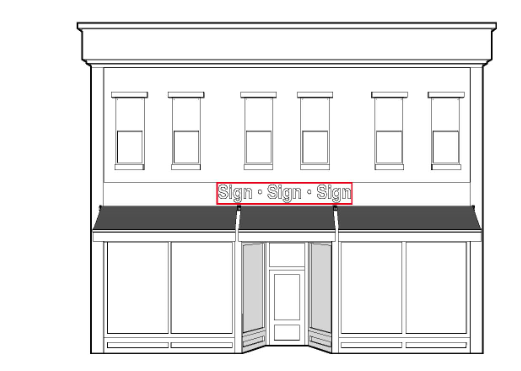
A.Sign Area. Measured in square feet (“s.f.”) and calculated as the width multiplied by the height of a single rectangle, parallel with the ground, that contains all sign elements, including decorative embellishments, and any internally illuminated or backlit panel, fabric or similar material not approved by the Planning Commission or Governing Body as an architectural design element of the final development plan approval.
|
Sign Area
|
|
|---|---|
|
|
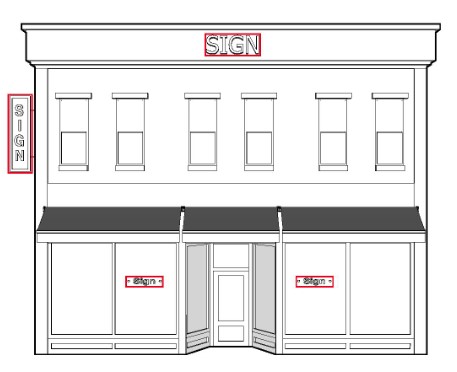 |
| Single sign area calculation | Sign area calculation for muliple signs |
-
1.Sign area includes cabinets, background panels or colors that are part of the sign installation and not part of the building architecture or the sign support.
-
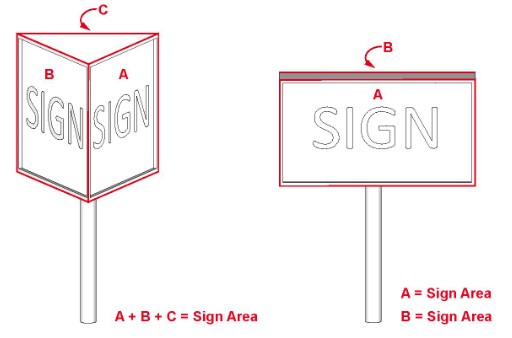
2.Only 1 side of a multi-faced sign shall be considered when determining the sign area, provided that the faces are equal in size, the interior angle formed by the faces is less than 45 degrees, and the 2 faces are not more than 18 inches apart.
-
a.Where the faces are not equal in size, but the interior angle formed by the faces is less than 45 degrees and the 2 faces are not more than 18 inches apart, the larger sign face shall be used as the basis for calculating sign area.
-
b.When the interior angle formed by the faces is greater than 45 degrees, or the faces are greater than 18 inches apart, all sides of such sign shall be considered in calculating the sign area.
-
|
Multi-Faced Sign Area
|
||
 |
||
| Sign area calculation for multi-faced signs |
-
-
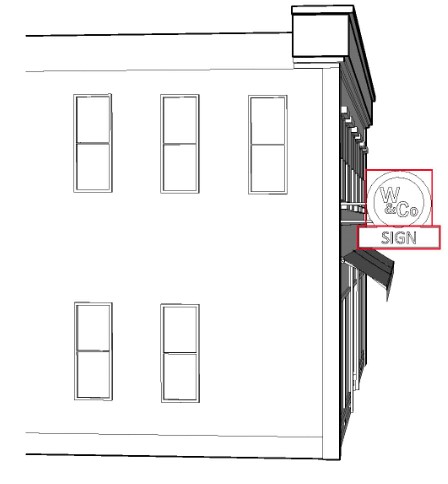
3.For irregularly shaped signs, sign area is calculated as the sum of 2 separate rectangles each containing a portion of the sign elements.
-
|
Sign Area - Irregularly Shaped Signs
|
||
 |
||
| Sign area calculation for irregularly shaped signs |
-
-
4.
For building-mounted signs allowed by this Chapter “per business”, all sign elements shall touch the facade of that particular business.
-
5.
The calculation of sign area for a single sign shall include all related sign elements on the same business facade or structure. Sign elements are related if they are all constructed in a similar manner and are located no more than 5 feet apart, horizontally or vertically. Additionally, in order to be considered a single sign, the facade on which the elements of the sign are mounted can be offset by no more than 5 feet.
-
6.
Where 2 or more signs are allowed on a facade, per the zoning district standards below, the separate sign area rectangles shall be added together to determine the total amount of sign area on that building facade.
-
-
B.Setback. No part of a freestanding permanent sign shall be located closer than 10 feet from any property line or curb line of a private drive, unless otherwise indicated.
-
C.Sign Height. Measured from the average finished grade to the highest point of the sign copy area.
-
D.Sign Support. Freestanding signs shall be securely fastened to the ground or a structure so there is virtually no danger that either the sign or the sign support may be moved by the wind or other forces of nature or cause injury to persons or property.
-
E.Illumination. Permanent signs may be illuminated via internal, indirect, and halo illumination configurations, unless otherwise indicated. Temporary signs shall not be illuminated.
-
1.Illuminated signs shall not operate at brightness levels of more than 0.3 foot-candles above ambient light conditions at the property line, as measured using a foot-candle meter. Illumination levels shall be measured in foot-candles with a meter sensor in a horizontal position at an approximate height of 3 feet above grade.
-
2.No rotating beam or flashing beacon light shall be used on any sign or sign structure.
-
3.Illuminated signs shall not blink, flash, or otherwise be used to display intermittent lighting sequences or to simulate motion.
-
4.Illuminated signs shall not be illuminated by flashing, intermittent, or moving lights, or consist of a static image projected upon a stationary object.
-
5.Except as provided in 18.440.100 and 18.440.110, the illumination source for a sign or building shall be hidden from view from any point on the ground by either an opaque or translucent material.
-
-
F.Digital Display. Where allowed, a digital display shall:
-
1.Include a sensor or other device that automatically determines the ambient illumination and is programmed to automatically dim according to ambient light conditions, or that can be adjusted to comply with the foot-candle requirement found in 18.440.050.E.
-
2.Contain static display only, and shall not have movement or the appearance or optical illusion of movement during the static display period of any part of the sign. Each static display shall not include any flashing or the varying of light intensity, and the display shall not scroll. The static display shall remain in a fixed position for at least 1 minute. An interval change time of 2 seconds or less is required. Exception: When approved by Special Use Permit by 18.440.120.C.
-
3.In the case of a malfunction, be turned off until repaired.
-
-
G.Changeable Copy. A manual changeable copy area shall be allowed in any allowed sign area.
-
H.No Hazard. No sign shall be erected such that its location, color, size, shape, nature or message creates a hazard or otherwise obstructs the view necessary for motorists, cyclists or pedestrians, or obstructs or is confused with traffic signals or other governmental signs.
-
I.Sight Triangle. Signs shall not obstruct the sight distance triangles (see 18.420.060) or otherwise interfere with the view necessary for motorists, cyclists or pedestrians to proceed safely through an intersection or to enter or exit public or private streets or driveways.
-
J.Maintenance and Appearance. All signs shall be of sound structural quality, maintained in good repair and have a clean and neat appearance. Land adjacent to signs shall be kept free from debris, weeds or trash.
-
K.Compliance. All signs and sign supports shall comply with all applicable federal, state and local laws, including the City’s building and electrical codes.
(History: Ord. No. ZRR-3300 §6, 2020; Ord. ZRR 3061 §1, 2015; ZRR 2427 §6, 2003; ZRR-1725; ZRR-1637; ZRR-889 §18.52)
Effective on: 1/1/1901